Friday, December 30, 2011

2012: The Year Ahead For Microsoft, Google And Apple


Next year will prove to be an interesting year for a lot of vendors. Market leaders like Apple, Facebook, Google, and Microsoft will face their greatest challenges and strongest opportunities, new arrivals will undoubtedly have us wondering why we hadn’t come up with a similar billion dollar idea, and in the U.S., we’ll likely have an election whose outcome will be controlled by computers for the first time. Granted, some of the concerns coming this decade will likely cause all of this to be trivial by comparison, but let’s look ahead to 2012 anyway.


Apple Litigation’r Us
We are still in the beginning rounds of Apple’s crusade against Android and some of the most contentious challenges are yet to come. Tim Cook, Apple’s current CEO, will have to perform in a role he was ill-prepared for given it was designed around Steve Jobs, a guy who not only was unique, but actually worked to remove anyone from Apple that he thought could replace him. This was because he was scared of being fired and was convinced up until the end that he would recover. Apple has Intel’s ex top attorney running their litigation efforts, who is considered to be one of the best in the business, but the courts likely won’t want Apple to kill off their competitors so this will hardly be a walk in the park. Expect to see Apple redefined by year end and we’ll see if they can pull a rabbit out of the hat with their rumored TV effort.

Facebook
The problem that Facebook will need to deal with this year is going public, which can do horrid things to a company from regulation and oversight to the distractions of instant mega-wealth. Mistresses, substance abuse, reporting shenanigans, and other problems have historically plagued firms that have gone through similar processes and Facebook will get a ton of cash to manage in 2012. They’ll need to anticipate and mitigate some of these instant wealth problems or they’ll likely look back fondly on the way things were before going public. It may sound great to be super wealthy, but a lot of families, executives, and companies don’t survive it.


Google
Google appears to have taken Steve Jobs’ final advice to heart and they appear to be focusing more and screwing up less. However, as we exit this year, there is a major effort to cobble them with anti-trust regulations. They have just been running to fast and loose and haven’t taken governments anyplace seriously enough and that could hurt them badly in 2012. Still their advertising revenue near monopoly remains largely untouched and they can take a lot of pain before the firm becomes unhinged. This year is the year we’ll likely see if the company can grow up to take full responsibility for its future and stop the practice of jumping all over the map with regard to products and efforts most of which are massively under-resourced. 2011 was a year full of mistakes; they can’t really afford another one like it.

Microsoft
Microsoft enters 2012 with three of their five pillar products at risk. Windows 8 is a massive gamble that people want PCs and tablets to merge and recall that their last, less forced, tablet effort didn’t go well.    IE is slipping in market share sharply year over year and if IE and Windows go, so does Microsoft Office.    I could argue that the last two pillars, Windows Server and Exchange likely can’ t hold without the other three, so if Microsoft fails this year, we actually could be talking about the end of the company next year.     Steve Ballmer will likely either be Microsoft’s biggest hero or the guy that destroyed the company by year end, depending on how well he resources platforms like Windows, Windows Phone, IE, and Office 365.   Given he, and the company, have historically under-resourced similar efforts goes to just how risky 2012 is likely to be for Ballmer in particular and Microsoft in general.


IBM
This will likely be a break out year for IBM and they just made a series of forward looking predictions.  Looking back on the predictions they made in 2007 for 2012, they hit more than they missed, suggesting it is worthwhile to listen to them. The company has a new CEO and they are heading back to CES with technologies that could make us safer and more productive.  IBM has led with the Watson project and is driving cognitive computing. In short, it appears they are moving to be the technology company again and for this old IBMer, that is a really cool thing to watch. IBM is looking pretty good.


Meg Whitman’s HP
Another big company undergoing change is HP. They still have a great deal of mess left over after Mark Hurd left the company, but they have stabilized their structure and are working to fix a number of the internal problems like the lack of a succession plan. The next CEO is expected to be groomed from inside for instance. In the end, 2012 is likely to both define HP and Meg Whitman’s futures and both likely know it. They appear driven to make a positive change and 2012 will likely be when we find out if Whitman’s HP can rise out of the drama that has surrounded he company for the last decade.


Wrapping Up
2012 looks to be an amazing year of change. Google still seems to be on the unfortunate path of emulating Microsoft’s historic mistakes and Microsoft is on the cusp of either re-emerging or collapsing depending on its executive leadership. IBM is shooting for the stars and HP is undergoing a major makeover. Facebook will face its greatest challenge yet, too much financial success too fast, and they won’t survive it unscathed.

Rob Enderle in Business on December 29

Wednesday, December 28, 2011

Microsoft Is Why Firefox Is Worth A Billion Dollars To Google


Analysis – Google is rumored to be paying at least $1 billion in advertising revenue, or royalties, depending on your view, to Mozilla over the next three years. This investment may seem over the top, especially since Mozilla has seen its market position weaken in 2011 and since we have seen plenty of public Mozilla firing poisoned darts in the direction of Google’s Chrome team. However, even at a billion dollars, it’s a good idea for Google to have Mozilla on its side. It appears that Mozilla has played its cards very well.

dollar money tree

The deal between Mozilla and Google is a perfect example how complicated the browser landscape has become and how critical it is to the core businesses of those who aim to control a major portion of the next computing era that will be focused on software services rather than software that is installed locally and processes most of its data offline. It is also a sign for users that especially Google and Microsoft are competing for their attention and they will go to extreme lengths to bind users and keep them from straying away.

Scatter Shooting
There has been an unusual amount of speculation why Google may pay that much for a browser that apparently is in an unstoppable decline and has fallen off the cliff of user interest. A Chrome developer as well as Firefox product manager Asa Dotzler responded to that speculation with posts that balance each other out, but may not reveal the entire picture of the relationship between Google and Mozilla, which is still very much defined by symbiotic advantages today. Much of the impressions we get today from either side are possibly incomplete and confusing as a result.

Peter Kasting and Asa Dotzler
Google’s Peter Kasting has published a rant on Google+ and complains that no one understands why Google has an interest in Mozilla. He explains that “the primary goal of Chrome is to make the web advance as much and as quickly as possible. That’s it. It’s completely irrelevant to this goal whether Chrome actually gains tons of users or whether instead the web advances because the other browser vendors step up their game and produce far better browsers. Either way the web gets better. Job done. The end.” At $1 billion, some may argue that this is a rather expensive venture and it may be difficult for Google’s CFO to explain to shareholders that there is just too much money laying around at Google to find other ways to invest into ventures that actually increase its revenues and profitability. Admitted, Kasting concludes that “Google succeeds (and makes money) when the web succeeds and people use it more to do everything they need to do.” However, one would be very naïve to believe that Google is interested in a constantly improving Internet to improve our lives. We may be closer if we said that the Internet will improve in the way it best aligns with Google’s interests.

Asa Dotzler, Firefox product manager, took a different direction to explain the deal. Dotzler explained that the deal is about advertising revenues and since Mozilla still delivers substantial value in that respect.


Market scenario at the end of 2011, outlook for 2012
As we are approaching the end of this year, we are seeing Firefox stabilize in market share just above 25%. Our estimate is that StatCounter will report about 25.43% for this month, which is down 5.25 points or 20.64% for the year. Chrome will be posting its best month yet with a net gain of 1.56 points this month and climb to 27.25%, up 11.59 points or 42.50% for the year. Microsoft will be dropping below 40% for the first time and land at about 38.60%, down 7.4 points or 19.17% for the year. As Microsoft’s advertising campaign for IE ran out in December, IE experienced a sudden drop in market share, down 5.0% from November and its steepest decline in 24 months.

Our estimate currently sees Chrome overtaking IE as the dominant browser In Q3 of next year. The introduction of Windows 8 is unlikely to have a major impact on browser market shares. Mozilla is dealing with a bunch of problems, especially feature delays that have made it nearly impossible for the company to recover and return to possible growth in H1 2012. However, H2 will be the timeframe where Firefox could get interesting again.

Negotiation Leverage
One of the key lessons in successful negotiations is to follow an aggressive path that is driven by selfish motives. While it is good to know as much as you can about your opponent, it is more important to know what you want and understand what you can get. If you know your value, your leverage grows and it’s easy to walk away from a deal if you don’t get what you want. That strategy works in simple environments such as dealing with a car sales people and it works when you are dealing with contracts that are worth billions of dollars. Mozilla has strong leverage and all information we have point to a setup of the talks that were handled by Mozilla’s executive team extremely well.

Mozilla’s primary leverage was not market share. Microsoft was Mozilla’s leverage. Since the development of a Bing’ed version of Firefox it was more than clear that Microsoft is interested in Mozilla’s user base to use Bing instead of Google. Rumor has it that Microsoft was willing to guarantee Mozilla up to $250 million per year in search box royalties, a number that was fueled by Microsoft trying to get hooks into Google’s business. Now that Google has prevented a Mozilla/Microsoft partnership, it would be interesting to know whether this new deal comes with certain conditions such as special support for Mozilla from Google, or a limitation whether a default Bing-version of Firefox is still possible or not.


Advertising, Advertising x2
Advertising is, of course, still a big deal. Mozilla still has 400 million users and those users generate ad revenues. If Mozilla still has 25% of the browser market, it is safe to say that the lion’s share of those users will stick with the default search engine and that is good news for Google. More importantly, however, Google made sure that those 25% did not go to Bing. Consider the investment to carry protective value as well.

Chrome follows Firefox follows Chrome
Given Chrome’s strong growth and the fact that Firefox revealed an extremely volatile user base on its edges this year, there was the clear implication that Firefox could become an important tool for Microsoft to work against Google while securing space for IE9 and IE10. Also, consider the fact that neither IE nor Chrome has the market majority at this time and it is unlikely that either one will gain it in the near future. However, both can gain market leadership with the support of Firefox. With Firefox as a technology partner, Google has 53% of the browser market and Microsoft would have 64%. It is much easier to push new features out into the market with Firefox than without. A partnership facilitates such an environment in reasonable terms. In the past Chrome adopted browser features that were first pitched by Mozilla staff, but were developed much faster for Chrome. This has been the case, for example, for the modification of the location bar layout or the integration of the Gamepad API. However, Google will also need Firefox to quickly adopt new features that are put into Chrome (and that make sense for Firefox as well ), such as SPDY. The additional funding should help Mozilla build out its resources and add features faster.

Migration Path: IE > Firefox > Chrome
Both Mozilla and Microsoft are struggling with user loyalty these days. While the two are trying to figure out how to not lose users, Google is harvesting the users both drop. In 2010, the user migration path was mainly from IE to Firefox to Chrome, but began to change as Firefox 4 was increasingly delayed and it appeared that IE users were directly moving toward Chrome as well. In the end, Google could care less if its Chrome users are coming from IE or Firefox, but having IE users migrate to Firefox as well and establish a well-defined migration path is in Google’s interest to strengthen its market position as far as advertising is concerned.

Antitrust Issues
Peter Kasting indicated that Google does not view Firefox as a rival, while Mozilla left no doubt about the fact that it sees Chrome as a rival. Let’s be honest and admit that both browsers are competing for market share and there is a competitive environment as a result. Dramatic changes to a market always draw attention and if they are serious enough, the government will get involved. Neither Google nor Microsoft can afford that Firefox goes away, but both need Firefox as an alibi to be able to push their respective strategies. With Firefox around, it’s a thriving market that values competition and remains antitrust-concern free. Even better if both sponsor Mozilla and a $1 billion payment goes a long way preventing anyone at the DOJ from getting silly thoughts. In a way, this investment could give Google a carte blanche to develop Chrome and push the browser in any way it wants to.

Wolfgang Gruener in Business on December 27

Thursday, December 22, 2011

Why The Nexus Tablet Cannot Beat The iPad


The Kindle Fire has showcased that a product well differentiated with a strong user experience running Android has the potential to challenge the iPad’s shipment numbers. However, Amazon had to create a unique Amazon controlled version of Android to make the Fire approach its potential. Google may not do what is necessary to achieve a similar result.

Google

Out from Apple’s shadow
Google appears as a company that has lost its way. They started out with the goal of making the world’s information available to everyone. They have since wandered off to doing everything from operating systems, to self-driving cars, to alternative energy products. Steve Jobs, before he passed, even commented that the firm was being known for its lack of focus and its tendency to bring out junk as a result.

When Apple wanted to bring out the iPod, the product that redefined that company, they didn’t copy anyone else and the end result was a line of products that positively define the company. Android was Google’s attempt to copy Apple first with the Nexus Phone and now with the Nexus tablet. The phone never approached the iPhone in terms of success and the tablet will likely end up the same. No firm, including Google, can become better at what another firm, like Apple, is expert at unless Apple badly stumbles, which appears unlikely at this point. But even if they were successful, all they would be is a clone of that earlier effort.

In the end, all Google is doing is trying to be a better Apple, which wasn’t their initial goal and the effort just suggests they can’t innovate themselves anymore.

The quintessential Google tablet
So if it’s not a clone of the iPad, what could Google do instead that would better define an effort representative of them? Google is about providing the world’s information to anyone, anytime and anywhere.  Why not, instead of focusing on a device that, at its core, is about playing music and videos, design a device that was optimized for information capture and discovery? Make the Google tablet great at capturing and indexing moments and in learning about its user so that it can offer up content kind of like Amazon and Netflix offer up stuff based on what you’ve purchased or watched before.

Tie the experience back into a social network so that the training and activity by one user can be, with permission, spread to other users making the entire eco-system grow synergistically in both power and accuracy and you could have something that could both be uniquely Google’s and it might even have the potential to overshadow the iPad. In the end, though, Google should be focusing more on finding a way to build products that accentuate its strengths rather than Apple’s and build a future that isn’t stolen from someone else.

Beating the iPad?
In the end, I actually think this is a bad question because Google and Apple are fundamentally different companies. Rather than beating Apple or Microsoft, for that matter, Google should still be focused on becoming a better Google. Keeping that in mind I think they could build a personal technology product that could eventually overshadow Apple, I just don’t think they get there by first copying the other company.

Rob Enderle in Business Products on December 21

Wednesday, December 21, 2011

New Firefox for Android Experience Optimized for Tablets


Firefox for Android introduces a completely redesigned experience that is optimized for tablets and makes mobile browsing more intuitive. New tools in Firefox enable developers to create interactive mobile Web experiences.


Firefox for Android leverages large tablet screen sizes and optimizes popular features for tablets. The Awesome Screen integrates Firefox Sync and makes it easy to access your browsing history, open tabs, bookmarks and saved passwords across desktop and mobile devices so you can type less and browse more.

Tabs appear as thumbnails in the left panel so you can quickly switch between them while still viewing full websites on the right. You can swipe to the left to hide tabs for a full screen view.
Firefox optimizes your Web experience for both portrait and widescreen mode. In portrait mode, tabs are listed in a top left menu and easily hide when you don’t need them, allowing you to focus on the websites you visit.

With the new Action Bar menu (next to the Awesome Bar), you can access Firefox Preferences, Add-ons, downloads and more. The Action Bar adds the back, forward and bookmark buttons for easy access. One-touch bookmarks enable you to add an icon to your Android home screen for your favorite websites and Web apps, making Web apps as easy to use as native apps.

Developers will enjoy new HTML5 tools in Firefox that make it easier to create fun and interactive mobile Web experiences for phones and tablets. The HTML5 Input Tag for Camera Access enables developers to make websites and Web apps more powerful and interactive. Developers can build mobile websites and Web apps that allow you to use the camera on an Android phone or tablet to take pictures, scan bar codes and more without leaving Firefox. You can see a demo of the camera input element in action here.

Firefox for Android supports the HTML5 Form Validation API which automatically validates website form fields like numbers, emails and URLs without developers needing to write a custom code or use a third-party library.

Major JavaScript Enhancements Make Firefox Speedy – up to 30% Faster


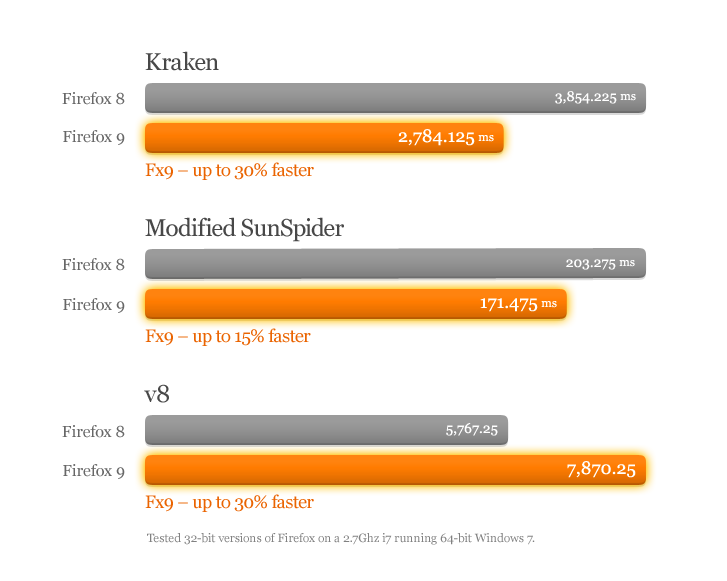
Firefox for Windows, Mac and Linux has new JavaScript enhancements that make Web browsing significantly faster. The latest update to Firefox includes Type Inference which boosts JavaScript performance and allow rich websites and Web apps with lots of pictures, videos, games and 3D graphics to load and run much faster. Type Inference is a feature of the SpiderMonkey JavaScript engine that integrates with the JaegerMonkey JIT compiler to provide analysis and help generate more efficient code. Firefox with Type Inference is up to 30% speedier on JavaScript benchmarks like Kraken and V8.

Firefox for Mac OS X Lion supports two-finger swipe gestures so you can easily navigate between websites. Firefox for Mac has an enhanced look and feel that matches the Mac OS X Lion icon and application toolbar styles and makes it easier to browse the Web using multiple monitors.

Web developers will notice Firefox helps websites load much faster, especially sites that download large sets of data or use AJAX. Firefox supports chunking XHR requests, allowing websites to display content as it’s downloaded instead of waiting for the entire download to complete. For more details about the new developer capabilities in Firefox, check out the Firefox for Web developers page.

Mozilla Renews Google Royalty Deal Until 2014


Mozilla announced that it has signed a “significant and mutually beneficial revenue agreement with Google”, which ends speculation that Google could possibly moving on and not support Mozilla via the browser’s search box and the integrated default Google search anymore.

Mozilla

Mozilla’s CEO, Gary Kovacs tweeted that today is “great day for the Web” and wrote in a blog post that “this new agreement extends our long term search relationship with Google for at least three additional years.” Kovacs did not reveal the financial terms of the agreement.

The previous 3-year contract defining the royalty agreement between Mozilla and Google ended in November. Over the past three years, Google’s Chrome browser gained substantial market share and recently surpassed Mozilla’s Firefox, according to StatCounter. However, Firefox market share is still around 25 percent and Google’s core business depends on search engine advertising revenue. It is unlikely that Google will be dropping those 25 percent of users and handing Microsoft and opportunity to pick up Firefox users for Bing.

It is unclear how much Google paid in search royalties to Mozilla in 2011, but we know that Google paid 84 percent of all search royalties in 2010, $121.1 million in total, were paid by Google. However, Mozilla’s market share was above 30 percent at that time, according to StatCounter, and it is likely that Google has paid less in 2011. For Mozilla, the renewal of the Google contract, is a way to end a not so great year on a positive note.

Daniel Bailey in Business on December 20

Firefox 9 Live Now: Firefox 11 and 12 Will Count


Mozilla has released the final Firefox version today. Officially, it’s not Firefox 9, it’s just a new version of Firefox that delivers major JavaScript enhancements, But it is really Firefox 11 and 12 we are waiting for.
Mozilla has released six new Firefox versions this year, beginning with Firefox 4 on March 22 and Firefox 9 almost nine months later. It seems to be a huge improvement over 2010, when Mozilla needed well over a year to get Firefox 4 ready for a release. In some way, the rapid release cycle has worked very well and Mozilla appears to be on a roll: New releases get pushed out much faster. What is missing, however, are a similar flow of new features as well as the positive impact of user recognition that was supposed to go along with the rapid release cycle.


Mozilla says that Firefox (9) is about 30% faster in JavaScript applications and first benchmark runs indicate that this is about right. “The latest update to Firefox includes Type Inference which boosts JavaScript performance and allow rich websites and Web apps with lots of pictures, videos, games and 3D graphics to load and run much faster,” Mozilla said. “Type Inference is a feature of the SpiderMonkey JavaScript engine that integrates with the JaegerMonkey JIT compiler to provide analysis and help generate more efficient code. Firefox with Type Inference is up to 30% speedier on JavaScript benchmarks like Kraken and V8.”

In Mac OS X Lion, Firefox “supports two-finger swipe gestures so you can easily navigate between websites. Firefox for Mac has an enhanced look and feel that matches the Mac OS X Lion icon and application toolbar styles and makes it easier to browse the Web using multiple monitors.” All remaining additions are mainly targeted at the tablet version of Firefox. Among all Firefox releases, Firefox 9 is certainly the most significant just behind the Firefox 7 release, which came with memory improvements.

Firefox 10, which is now in the beta channel, appears to become a patch and maintenance update, while version 11 could be more significant with the introduction of (incomplete) silent updates. Version 11 will also get a new New Tab page and a Chrome migration data toolset. Version 12 is expected to complete the silent update feature, finally integrate web apps in the desktop and deliver a panel-based download manager. That is the good news – the not so good news is that Firefox 11 will not be released until March 13 and Firefox 12 not until April 24.

You can download the new Firefox version here.

Daniel Bailey in Products on December 20

RIM May Need To Die For Blackberry To Survive


Every iconic brand is a precious asset that needs to be taken care of in order to fulfill its purpose of carrying and protecting a business. Blackberry may be become a paper book example just how much damage a brand can survive and when it is time to start from scratch. As we are wrapping up 2011, it appears that RIM has managed to entirely wreck its reputation on every level and maneuvered the company into a ditch it may not be able to leave anymore. RIM is beyond repair.

In 2003, RIM was a rising star with a bright future. I can remember Mike Lazaridis, co-CEO of RIM, bursting with confidence in an interview I did for a client; he was laser-focused on the company’s vision of delivering the best phones for corporate users. Back then, RIM owned the mindshare of the requirements of the time – completely locked down phones that provided ultimate security. Back then, Lazaridis even stated that camera phones were out of the question as they would be rejected by corporate users. He noted that Blackberrys may get media players, though. The market demands may have changed over the past eight years, but it was very apparent that Lazaridis understood the market he was in. Sometimes after that, probably just around the time the original Pearl consumer phones were introduced, RIM lost its focus, which was exposed in a brutal way by Apple’s iPhone in 2007.

Blackberry Bold 9900 / 9930

Like Nokia, RIM felt it had all the time in the world to continue on an increasingly blurry path, but ignored a changing market and, perhaps more importantly, an unprecedented opportunity to change wireless communications and open entirely new markets. As a result, RIM lost its dominance in the corporate market and delivered half-baked phones in shoddy build quality and a software platform with a mix of business and consumer features that lost touch with reality from version to version. RIM turned from the company that was setting communication trends into a company that was too fat to even follow a rapidly evolving market, let alone innovating with those that were changing it.

RIM’s unfortunate development peaked last week when RIM reported its third quarter results, which showed a slight revenue decline year over year and a still solid $265 million profit. However, there is no denying that RIM is in trouble and the voices that are expecting actions instead of phrases that invoke hope for a miracle are becoming louder. Yet, RIM is paralyzed and incapable of initiating the dramatic change that is necessary to save the company and the Blackberry brand in the place that has the responsibility to do just that: It’s C-level leadership. Like a couple of drunk RIM senior executives that recently embarked on an embarrassing episode on an airplane and forced it to be diverted due to their behavior, RIM’s top management may be in a state where they are engaging in unreasonable behavior that is bringing the entire Rim-craft down.

During the conference call, co-CEO James Balsillie said that he and Lazaridis “are leaving no stone unturned and are evaluating a number of areas, including product management and the number of SKUs offered, supply chain and building material cost efficiency, marketing and advertising, partnership and licensing opportunities, organizational and management structure and opportunities to leverage the BlackBerry infrastructure.” Is it just me or is this a statement of someone who is already standing on an cracking ice cover and desperately asks for a thread to hold on to something that is dying?

Lazaridis repeated the “no stone unturned” phrase, which sounded almost surreal, if you consider the fact that it is too late for stone-turning at RIM. Customers have been leaving in droves, as a result of a lack of innovation, focus and dedication. The iconic Blackberry is in shambles and what once appeared to be a rock solid brand is worth little more than Balsillie’s and Lazaridis’ promises that investors don’t buy anymore. Desperate efforts and pleas that Blackberry can be saved with a new technology platform and new products in the pipeline do not cut it anymore when customers are convinced that there are dozens of better choices out there. I cannot remember how often I read from people on Facebook that they could not wait to ditch their corporate Blackberry for a BYO iPhone. Years of bad product quality, virtually non-existing (consumer) customer support, marketing failures with highly questionable product names, and terrible software can’t be wiped off the table. It is time for a dramatic move. Balsillie and Lazaridis will have to consider leaving if they want their Blackberry to survive. Along with them, the baggage of RIM should die.
From our perspective, Blackberry should become its own company and go hiding for a year or two. Blackberry needs to start tabula rasa and ditch every product it has right now. Simply trying to catch up with Apple and Google will only delay its death. It may be better to take the losses for an entire year and then rise from ashes with something completely new, something that is focused to a specific customer group like the original Blackberry was. This time, however, the company should take emerging threats more seriously.

Wolfgang Gruener in Business on December 20

Saturday, December 17, 2011

Can Firefox Become A Game Platform?


Mozilla can use all the support it can get at this point. Both Google and Microsoft are being focused on their future platforms, but there has been little reported news this week about the developer preview of Mozilla (Labs) Apps, which provides a first glimpse at Mozilla’s view of an open apps platform for the web. A detail of Mozilla Apps is an opportunity for Mozilla to follow Google into the entertainment and, specifically, in the game market.

Some thoughts of Mozilla’s path into gaming are provided by Rob Hawkes, an HTML5 programmer, who recently published notes of Firefox features that would support a focus on gaming. According to Hawkes, currently developed functionality for games would include BrowserID to identify players, the Full Screen API for a traditional gameplay experience, the Mouse Lock API to “tame” mouse pointers, the Gamepad API to support gamepads, as well as real-time multiplayer support via Web Sockets.

Mozilla

These features are following Google, which should be credited for kicking off the Gamepad/Joystick API standardization at the W3C (Mozilla was first to publish the idea), driving more features such as WebRTC, and is engaging some efforts to give web games more visibility via tradeshow events. Google is also looking further into supporting technologies, such as its Native Client (NaCl) which enables a path to get traditional C code to run in a browser window. Microsoft has been pursuing a similar strategy by pushing its hardware acceleration engine in IE9, which still leads Firefox and Chrome in demanding HTML5 tests such as WebViz and will be enabling Microsoft to spark the development of entertainment apps that take specific advantage of the features in IE9/10.

Despite the fact that Mozilla has been notably quieter in this arena, Firefox 4 and up has always be a very capable HTML5 browser and we even found it to be the best compromise between IE and Chrome in a review earlier this year. In fact, Mozilla may have, especially because of its open approach a massive opportunity to approach gamers. There are still 400 million Firefox users, according to Mozilla’s own claims, which is nothing to sneeze at. However, the concern is that Mozilla is losing market share, while Chrome is gaining quickly and is winning this game against its rivals. In the first half of December, Chrome has a market share of almost 27%, while IE dropped below 39%, according to StatCounter. Mozilla gained slightly to 25.5%. However, Chrome 15 has been, by far, the leading HTML5 browser with a 23% share, followed by Firefox 8 with about 15%. IE9 is at about 10.5%.

Mozilla has a clear opportunity in game applications and it may be worth a shot to go much more aggressively after this market.

Wolfgang Gruener in Business Products on December 16

Friday, December 16, 2011

IE Silent Update: A New Way To Look At Microsoft’s Browser


Microsoft’s decision to begin updating Internet Explorer browsers to overcome update fatigue and a painstakingly slow upgrade rate is a major update for the browser. The company will introduce the feature in some geographies in January and scale it from there to be able to fend off Google’s Chrome.

ie logo

Microsoft, Mozilla and Google have very different approaches to market their web browsers. Both Mozilla and Google have been severely impacted by Google’s aggressive strategy to drive Chrome to computers. Mozilla is still struggling with the changes it decided to make to its development process earlier this year and it seems as if Mozilla’s worries could get worse as Microsoft is preparing itself for a browser battle with Google.

Microsoft announced that it will be launching a silent update feature for IE8 and IE9 in January, which will be limited to Australia and Brazil initially, apparently for testing purposes, and scale from there. The process will work similarly to the silent Windows Update process and inform users when an update is ready to install. Users who declined updates previously will not be updated to new browser versions automatically. Of course, there is still the controversy that silent updates remove authority from users to decide when it is time to upgrade browsers and when not. However, there is no denying that automated browser updates most likely improve the security of a browser on a client system, automated updates are a great marketing tool to deliver the perception of an always fresh browser and, of course, it helps Microsoft to avoid scenarios in which it gets stuck with an old browser it can rid of – such as IE6. If there is one browser that shows evidence of update fatigue, it certainly is IE.

A defense against Google, a problem for Mozilla
This particular feature that will support IE8 and IE9 systems will also help Microsoft to move its users faster from IE8 to IE9. IE8 just lost its role as most popular browser to Chrome (15) this month, with a share of 22.28% to 23.94%, according to StatCounter. 10 months after its introduction, IE9 has a share of just 10.42%. Even on Windows 7 systems, a heavily marketed platform for IE9, the browser has less than 25% share. Market share trends suggest that virtually all of its market share losses are turned into gains for Chrome. As long as Microsoft can get IE6 and IE7 users to IE8, it has now a direct upgrade path to IE9/IE10 and Windows 7/Windows 8. Conceivably, the silent update for IE has been overdue for quite a while and should have been introduced with IE9 earlier this year. Silent updates could have kept a significant number of mainstream users from switching to Chrome.

Mozilla has had a tough 2011 already, but this announcement may be the icing on the cake. Mozilla has been working on the silent update for months and just announced that the feature has been pushed back to version 11, which will not be released until March 13, 2012. With Google and Microsoft bringing out the big guns and two giants quite obviously positioning their artillery on a growing battlefield, Mozilla’s role has changed from being a challenger to an outsider. That can be good news as some of the focus on Mozilla fades and it has an opportunity to rebuild itself in 2012. However, it won’t have a substantial impact in 2012 as IE9/10 and Chrome will be drawing all the attention and there is a good chance that IE9/10 will look more attractive next year than IE has in more than 15 years.

Wolfgang Gruener in Products on December 15

Google Patents Transition To Autonomous Driving For Cars


Google has just been granted a patent that describes a possible switch from a car that is driven by a human to an autonomous driving mode. The patent was written by a group of engineers that includes the winners of the 2007 DARPA Urban Challenge.

We have heard quite a bit about Google’s autonomous cars driving around in California. A patent approved by the USPTO yesterday provides more detail on these cars and the technology they may use. The patent #8,078,349, filed on May 11 of this year, specifically refers to the event when a mixed-mode car is enabled to transition from a human driver to an autonomous mode.


According to the patent, Google is envisioning a landing strip for a vehicle. Only a landing strip that can be detected via sensors in addition to a GPS locator may be able to deliver the necessary detail to determine the exact location of a car, provide the vehicle with that location data and allow it to switch to an autonomous model. The patent stated that the location data as well as operation instruction can be provided via a URL. If such data is given to the vehicle, it may also receive information that it “can only operate in one predefined path.” At the very least, potential applications would be industrial vehicles as well as future cars that may park themselves in a parking lot. Keep in mind that these services could be closely tied to Google’s mapping services, which may be the connector to Google’s interest in this technology.

To develop this technology, Google employs some of the smartest minds in the industry. It is not really surprising to see Christopher Urmson and Nathaniel Fairfield listed among the inventors: Both joined Google from Carnegie Mellon’s Robotics Institute. Urmson was the technical leader of the Tartan racing team, which won the 2007 DARPA Urban Challenge: Their “Boss” vehicle, a heavily modified Chevy Tahoe, completed a 55 mile urban course in 4 hours and 10 minutes and won the $2 million prize of the competition. Also listed among the inventors is Nathan Fairfiled, also from Carnegie Mellon’s Robotics Institute, who worked on sonar data for navigation in 3D environments at the university.

Kurt Bakke in Products on December 14

Wednesday, December 14, 2011

Is Burt Rutan About to Become the Bill Gates of Space?


I spend a lot of time going back and looking at what made Microsoft great largely as a contrast against what the founders are currently doing. At the beginning, what made for a successful start was that Paul Allen, clearly the idea guy, figured out he needed someone with the drive to complete the vision and if he hadn’t found Bill Gates, Microsoft would have been a small footnote in technology history. Since then, Paul Allen has had a lot of ideas, many of them good ones, but he never found another Bill Gates again.

One of those ideas is to create a relatively inexpensive way to launch rockets into space and, given this could benefit everything from providing space based streaming video capability and global phones cheaply to dumping nuclear waste into the sun, this could be even bigger than Microsoft.


Stratolaunch
The Stratolaunch concept isn’t really new. The idea of lowering cost by launching from an aircraft has been talked about for some time and some space based weapons are launched that way today. What makes this different is the scale, because most of those earlier ideas were based on existing aircraft and the size of the launch vehicle was pretty small. This idea uses a massive aircraft, which would be the largest ever made and a launch vehicle that could lift everything from space lab components to people into space. This is a relatively heavy lifter and likely critical to making trips to the Moon or even Mars affordable enough to once again being considered.

This is important because the US is in another space race and China and Russia have taken over the lead in it as their costs were vastly less than the US’s for the Shuttle. Currently, the U.S. is increasingly relying on Russia for a lot of its heavy lift capability, particularly people, and given the initial space race was with Russia, that implies they may have eventually won it for now. Not by being first, but by having a more acceptable cost. They can even take rich people into space on a junket.

The really cool part of this is that launches could occur out of airports equipped for large jets and not require the massively expensive launch facilities that rockets currently require with the possibility of massively undercutting China and Russia’s costs and once again establishing the U.S. as the leader in space.

It is often argued that the winner of any battle is the one that gets to the high ground first and, in a world of limited resources, it seems strategically foolish to allow other strong countries to establish this high ground.

Rutan – Gates
Like Bill Gates had with software, Burt Rutan has a passion for flight and is well recognized as one of the most qualified to lead an effort like this. Unlike Allen was at the start of Microsoft, he is very wealthy now and has a substantial amount of political clout, a necessary element when you are talking about competing with NASA.

Unlike Microsoft, this won’t be about putting a piece of software on each of our desks, but on putting the U.S. back into the lead in the race to commercialize space and, given this country needs every commercial opportunity it can get at the moment, it could end up saving the country’s economy much more than Microsoft did.

Stratolaunch Systems will showcase whether Allen and Rutan can build another Microsoft. For the future of the U.S., I sure hope so.

Rob Enderle in Business on December 13

Tuesday, December 13, 2011

Windows 8: The App Store To Rule Them All?


One advantage from coming to the market late is that you get the chance to look at everyone else’s offering and make yours better. Not that everyone takes that opportunity mind you given how many product clones are out there that don’t come close to the original. However, in this case, Microsoft’s announced App store looks like it took the best and worst from the Google and Apple efforts and created something better. Granted, it won’t show up in final form for about a year and will have to evolve during that time to stay ahead of Apple and Google by launch, but it does show Microsoft listened.

Problems with the Apple App Store
Apple’s store is the gold standard, more people are making money using it than using Google’s, Apple isn’t having the malware problems that Google has, and the average quality of the Apple App store appears to be higher (likely because this is where people tend to focus their app efforts). However, this store has had issues with being overly aggressive in terms of killing popular apps from those that are political to apps that appear to compete with Apple’s own offerings to apps that seem to do things Apple doesn’t want to be done.

In addition, people who develop for this store often complain about the approval process where your app goes in, but doesn’t seem to come out anytime soon – and if it isn’t approved, the reason isn’t often clear. Finally, Apple is pretty aggressive when it comes around to sharing revenue in that they want a large chunk (30%) of it even if what you are doing is selling books through your own free book app.

Windows 8 Start Screen
Windows 8

Problems with the Google App Store
Google is vastly more free and easy and they allow side-loading, which means you don’t even have to use their app store if you don’t want to. On the other hand, revenue, let alone profit, has been elusive to most developers and the Android platform has been highlighted by companies like McAfee as the place where malware is most likely to go to feed on your information. Not profitable or not secure isn’t a good combination for developers or users and recently Dell abandoned one of their products and Amazon forked it to create their own, more secure, version tied to their own app store.  In short, Google is easier to work with than Apple, but the downside is vastly more pronounced for both the users and the developers.

Microsoft App Store
Microsoft’s store will be heavily curated like Apple’s, but not restricted and the approval process is instrumented so that developers will know where their app is in the approval process. Side loading won’t be allowed by default and only in a controlled fashion. If you have an app like the Kindle eBook reader, anything you sell through it doesn’t come with a fee for Microsoft. Content apps are not taxed by Microsoft and their 30% fee on regular applications drops to 20% after the first $25,000. Finally, there are vast improvements in locating applications something that often proves to be a little difficult in the massive application repositories both Apple and Google have.

In short, from a developers perspective, granted once Windows 8 actually is purchased, they get more money from each sale and less aggravation through the approval process. From a user’s perspective they get less malware, more controversial applications, which they can find more easily. And from a competitive perspective, at least on paper, Microsoft has the best store if Windows 8 sells well, which, given the massive marketing campaign and size of the Windows base is at least plausible.

Timing
This impressive effort showcases Microsoft was listening in that it deals well with each of the shortcomings in the competitors’ products.  However we are about a year away from when Windows 8 comes out and a lot will happen with both competitive stores during that time.   We’ll revisit this when Windows 8 launches and see if it can maintain these or find other advantages by that time.

Rob Enderle in Business Products on December 12

How Google Can Quickly Update 200 Million Chrome Users


The development process of Chrome and the way Google has scaled the release of Chrome in an apparently effortless way to hundreds of developers and hundreds of millions of users is one of the big success stories in software development these days. A Chrome developer recently gave some insight in this release process and the pillars that allow Google to succeed with a model that causes so much headache for other software companies.

The notes come courtesy of Marc-Antoine Ruel, who published a summary of a presentation he gave at an agile development conference last month. Ruel’s explanations provide the most detailed information about the accelerated release browser cycle initiated by Google a little over a year ago. There is quite a bit of background information that sheds some light on Google’s philosophy how to deal with now more than 200 million Chrome users and update them “within 6 hours.”

In contrast to Mozilla’s open “rapid release cycle”, which is still very much a work in progress and is continuously discussed as being in need of improvements especially on the feature management side, the approach of  Chrome appears to be much more defined and aggressive toward a few focus areas that may not be so obvious to everyone at first sight. According to Ruel, a critical enabler for Google’s vision for developing and deploying Chrome surrounds the idea of reducing “friction” for developers, users, the software itself and the development and release of security fixes.

Google Buildbot

The published document invites comparison to Mozilla, which followed Google with a 6-week release cycle earlier this year, but has not been able to deliver on the promise of faster feature implementation so far. The intended benefits of an accelerated cycle are two-fold: First, software updates are less disruptive than an annual update with a greater number of changes to the software and, second, new features can be delivered to the user when they are available, and not just in an annual upgrade, which is, for example, still practiced by Microsoft with its IE10, which appears to be on a 12-month release cycle (or 2-month cycle, if we include security fixes and the release of IE browsers with minor version number changes).

If all works well, this “agile” software deployment can also result in tremendous learning how to deal with large user bases of web applications. The obvious downside of this development process is faster change for those environments that do not like change, including corporate environments, which heavily complained about Mozilla’s switch from a 6-month to 6-week cycle. Interestingly, this complaint has only hit Mozilla and not Google and Google largely ignores those complaints, even if it provides administration tools that enable system administrators to set their own pace of upgrades. However, Ruel’s document indicates that Google largely ignores those complaints and the company may be right in some aspects: Rapid releases have given Google a huge advantage in some areas that count – convenience for most users and the fastest deployment cycle of security fixes, which contribute to the perception of Google as being an always updated and secure browser. On many levels, Ruel’s presentation summary is a worthwhile read not just for those who are interested in Google’s ideas, but for all those dealing with the problem of how to translate agile software development for local apps to web apps.

Google Chrome Release Pipelining

It is apparent that Google does not take any chances on its master development branch. While most new features for Chrome are developed on this core branch, they are disabled just after “forking a release branch if not stable worthy”. This is the reason why there are more experimental features available on the canary versions than on the developer, beta and stable branches of the browser. Google makes black-and-white decisions about features that do not have a chance to go stable for the current release. If the feature is continued to be developed, it will have another chance for the next release. By the way, Google has four release versions in the works at this time: The stable version is at 15 and about to move to 16, while the canary and nightly branch goes down to version 18. Since the browser’s launch in late 2008, Chrome developers have applied more than 104,000 changes to the code of the Chrome. The best way to track those changes is the Chromium revision log, which logs every change made to the browser as well as to Chrome OS.

No matter which changes are made to the master branch, Google’s intent is to keep the master branch in a state that is always “shippable”. The company refers to the branching of Chrome versions as “pipelining” and the chart offered by Ruel certainly reveals why “pipelining” is an appropriate description for a process that includes parallel branches and accepts the abortion of entire branches should they fail quality assurance. Ruel said that pipelining also enables Google to bring “dot releases” to the beta and stable channel with the purpose of deploying security fixes. Overall, there is no code in the development process that is older than 3 months, which helps Google with code base refactoring – a problem Mozilla Firefox developers are currently dealing with.

Ruel also provided some information on the forced, automated update process used in Chrome and the way Google tries to be “respectful” to other applications running on a PC and, in the end, to the user. For example, to avoid extension breakage, Google offers a free ping infrastructure for extension developers, which enables an automated update of extensions within 5 hours in a worst case scenario. For the update process itself, Ruel said that Chrome never tests for updates on system startup as the system is overloaded anyway, it restricts the use of physical memory and the bandwidth that is occupied for auto-updates. Background processes are slowed to reduce CPU usage and increase battery life on notebooks. However, if an update, in fact, has errors and breaks especially security features for users, Ruel said that the “release team must always be ready to fire and manual [quality assurance] must be minimal.” According to the developer, Google occasionally notices problems and provides fixes even before users notice the breakage.
Recently, sandboxing has been viewed as Chrome’s critical advantage in security, but Ruel noted that the key to securing the browser is to deploy fixes fast, unnoticed by the user. “The basic idea is to update the system but make it almost transparent and hopefully magical to the user,” Ruel said. “Subtle enough that most users won’t realize but power users will act upon. In both Google Chrome and ChromeOS, we decided to add a little green arrow when an update is ready to be installed.”

Wolfgang Gruener in Business Products on December 12

Friday, December 9, 2011

Firefox May Not Recover In 2012


As I stumbled over a note from Mozilla’s developer staff today, I wondered how much impact feature delays in a rapid release process really have and whether delays in a 6-week release cycle matter or not? Firefox could use some good news, but there is not much that could cause some optimism in the near future. Nearly every major feature the browser could use today is delayed and the browser that Mozilla would need today won’t be available until the end of April.


There are not many words that can effectively sugarcoat Mozilla’s position in the browser market today. Chrome surpassed Firefox last month and has comfortably climbed above Firefox in the first few days of this month and now averages 26.75% share, which is more than 1 point above Firefox (25.46%). Chrome’s pace is rather stunning and raises questions whether there is a competitor that can stop Google from capturing a dominating market share in the browsers.

We have been somewhat optimistic that Mozilla could strike back with Firefox 10, but new delays of features are now reason for concern that Mozilla will not have an opportunity next year to gain some ground under its feet to establish a foundation for growth again. The silent update feature, which is one of the main reasons for Chrome’s success, will not be completed until Firefox version 12 as Mozilla said that the pushback from 11 to 12 was necessary “to mitigate risk of landing two large architectural changes to update in a single release.” The roadmap also indicates that the SPDY implementation for Firefox 11 is at risk and may not happen in that release. Chrome migration features and the Home Tab, both targeted at 11, are marked as “at risk” as well and could slip to version 12.

The feature additions for Firefox 10 mainly address the mobile version and the main upgrade for version 11 is a new tab page, web apps integration as well as a media controls refresh. It is obvious that new features require time to be developed and need to be matured for a final version, but we also notice that the Home Tab app has been in development for more than half a year. Given Firefox’ current market position, Mozilla may not be able to afford such delays. Especially critical requirements such as Mozilla’s Chrome migration tools, which would allow Chrome users to easily switch back to Firefox with data import tools, should be exposed to much higher priority and should be developed on a significantly faster pace. There is really no way around the problem that, even in a 6-week release cycle, Firefox is falling back in the browser race again. As it stands, it is difficult for users to understand why there is a 6-week cycle anyway as most new features unveiled this year could have been delivered via minor product updates.

Firefox needs to be at its strongest especially when Windows 8 debuts and to stand a chance to compete with Chrome. As we are ending 2011, there is not much that we can see that will change Firefox substantially until April 24, when Firefox 12 is scheduled for release – and that assumes that there will not be any further delays.

The impact of these delays will strongly depend on Mozilla’s competition as well as Mozilla’s capability to shift some focus to its OS Boot-2-Gecko. However, there is very little room for error at this time as Firefox is already on a decline and the more the browser falls, the more difficult it will be to regain popularity against Google and Microsoft, both of which are now building browser that aim to bind their users much closer to a web browser than ever before: Both Chrome and IE10 will be enabler for Google’s and Microsoft platform experience and tailored to their specific requirements.

So, what is the outlook right now for Firefox in 2012? Mozilla is clearly struggling with too many open ends. It has not provided a clear answer for IT managers and their corporate users what Firefox will be and how it will evolve and there is just not enough change for the mainstream user to spark interest for Firefox again. If there is a lack of focus and a development cycle that does not keep up with the promise of a 6-week release cycle, 2012 could become an extremely tough year for Mozilla.

The only way for Mozilla to compete with Google and Microsoft at this time is a much stronger focus on a diligent delivery of its roadmap.

Daniel Bailey in Business on December 08

Thursday, December 8, 2011

Six Android issues that Google doesn't want to address


Google executive chairman Eric Schmidt, there’s no doubt as to who’s winning the mobile war.

“Android is ahead of the iPhone now,” Schmidt told an audience at LeWeb in Paris. The room fell silent and Schmidt had to explain:

“Unit volume, Ice Cream Sandwich, the price is lower, there are more vendors.”

Currently there are some 200 million Android devices in circulation with some 550,000 being added daily, but Schmidt things that Android 4.0 (aka Ice Cream Sandwich) will give Android an extra boost, both in terms of sales and developer interest.

“Ultimately, application vendors are driven by volume, and volume is favored by the open approach Google is taking. There are so many manufacturers working to deliver Android phones globally,” Schmidt said. “Whether you like Android or not, you will support that platform, and maybe you’ll even deliver it first.”
But is size everything?  Getting Ice Cream Sandwich out of the door and onto handsets is only part of the equation. Let’s take a look at some of the challenges facing Android that Google doesn’t seem willing to address:
  1. What about updates? Data pulled together by Michael DeGusta back in October showed how seven of the eighteen Android phones had never run a current version of the Android OS, and how most current Android handsets will never see the Ice Cream Sandwich update
  2. Android handsets also top the hardware failure list, with 14% of all Android support calls related to hardware failures. These Android device returns alone is costing mobile operators a staggering $2 billion per year
  3. Then there’s the problem with apps. A sucky game is one thing, but what about the free Android anti-malware scanners ‘near to useless,’ with most products achieving 0% detection rate? Also, despite security researcher claiming that Android is not the major target for malware, Chris DiBona, Open Source Programs Manager at Google, continues to refer to security firms that warn of Android malware as ‘charlatans and scammers.’
  4. What about Flash support? Currently there’s no Flash plugin for Ice Cream Sandwich, and after this update is released, that’s it from Adobe. No more.
  5. While Google continues to offer Android to handset makers free of charge (don’t worry, Google still pulls in some $2.5 billion a year from ads displayed on Android devices), patent issues mean that handset OEMs are having to hand over millions of dollars every year to Microsoft. The only company that seems to be willing to leap to Android’s defense is Barnes & Noble.
  6. Oh, and there’s also that issue of bloatware installed by the handset manufacturers is making Android insecure. And that whole CarrierIQ thing.
I’d like to see Google put a little effort into addressing these issue. I know that the size of market share is important, but I think that these issues are also important for both Android users and handset makers.
If you’re an Android user, what issues matter to you?

By Adrian Kingsley-Hughes/ZDNet

Don't write off Mozilla-Google revenue deal as dead


Firefox logo

Mozilla and Google are renegotiating a deal by which Google shares ad revenue that results from searches the browser drives to its site.

The partnership, which Mozilla renewed in 2008 for three more year, was set to expire in November. With that deadline and a noncommittal comment from Mozilla, Ed Bott, who blogs at ZDNet, surmised in a headline: "Google deal apparently ends."

But apparently there's some wiggle room in the organizations' relationship and the Googlebucks are still making their way across Mountain View.

"We generally don't disclose specific terms of business agreements. We can confirm that we still have an agreement with Mozilla, but have nothing new to share at this time," Google said in a statement today to CNET News.

Mozilla added that the two are in negotiations:
Our search relationship with Google remains positive for both of us. We are in active negotiations and have nothing further to announce at this time. We have every confidence that search partnerships will continue to be a strong and growing generator of revenue for the foreseeable future.
Mozilla, although a nonprofit, needs money to operate. Google provides the lion's share of it--most of the Mozilla's $120 million in 2010 revenues, for example. Mozilla's statement about "search partnerships" leaves the door wide open for other search engines, but I'd be surprised if either party backs out.

With Chrome, Google of course has its own browser now, and clearly the company's competitive juices are flowing. But the overall objective of Chrome is to speed up the Web and improve it as a foundation for applications, not to squeeze other browsers off the Internet.

Mozilla is hedging its bets a little. Mozilla introduced Microsoft's Bing as a search-engine option with Firefox 4 earlier this year, and in October, Mozilla released a version of Firefox with Bing as the default search engine. Google remains king of the mountain for search, but such baby steps let Mozilla work out the kinks if it has to change.

Because, let's face it, Microsoft would love to have Firefox pointing its search traffic toward Bing. It's not clear how many people would change a Bing default setting back to Google, and if they did whether Google would continue to share search-ad revenue with Mozilla, but at a minimum, Mozilla has a little bargaining leverage here.

Chrome is gaining at Mozilla's expense in the fraction of browser usage, but even if Chrome edges out Firefox for second place, millions of people still will be using it. Does Google really want those people using Bing?

(Credit: Stephen Shankland/CNET)

New Opera tweaks its threads, mail client


Opera Mail gets a new wardrobe in 11.60.


Hardware acceleration is currently one of the major features missing from Opera that its competitors offer. It allows the browser to leverage a computer's graphics processor to cut down on page rendering times, including the rendering of complicated in-site graphics such as found in games.

Although it's not in Opera 11.60, the new version of Opera remains quite usable. The built-in mail client has been refreshed so it fits in with Opera's tweaked look, and adding multiple e-mail accounts took about 10 seconds each. Also on the interface front, the publisher has abandoned its native Windows design to favor a more universal default skin. Opera spokesman Thomas Ford said that this was so that more resources could be spent on the default look. He also predicted that most users wouldn't notice, since not many of them switched to the native Windows skin. The biggest difference between the two, he said, was that the color scheme was slightly lighter.

Looks aside, there have been some feature and functionality changes to Opera 11.60, too. Secure Web sites that load through HTTPS are expected to resolve faster because of improvements made to the code governing network connections and the new HTML5 algorithm for parsing code has been included so that the browser is compatible with more sites. A bit of new life comes to the familiar star button on the right of the location bar, as you can now use it to add a site to Speed Dial.

Opera is not exempt from the challenges facing modern browsers. While its growth on desktops has been negligible this year in terms of percentage points,Opera Mobile and Opera Mini are among the most heavily-used mobile device browsers around. The company has plans that could involve merging the two, but it faces both competition, such as from Google's attention to Chrome and Android browsers, and restrictions, such as those that Apple places on all third-party browsers on iOS

(Credit: Seth Rosenblatt/CNET)

10 Reasons to Upgrade to the Latest Firefox Version


Firefox
When there’s a new version of Firefox, some people rush right out and get it to make sure they have the latest and greatest! They want to take advantage of the advanced features, the security fixes, the blazing speed, the customization… well, you get the idea.

For some folks, however, upgrading takes a bit more thought and consideration.
We totally understand that. Hey, change is hard! But sometimes, change is also good, once you have all the information.

So here is a list of reasons that addresses some of the most-voiced concerns from our users and covers why you should upgrade to the latest version of Firefox.

10 Reasons to Upgrade to the Latest Firefox Version
1. It’s free! Many people are concerned about the cost of upgrading. You can take that worry off your plate right away. We don’t charge for Firefox. Not now. Not ever. The best things in life are free!

2. It’s easier than you might think. A lot of folks don’t want to upgrade because they think they aren’t tech-savvy enough or they might hurt their computer by doing something wrong. Some just plain don’t know how. Let us show you how easy it is! It only takes two minutes — heck, you can finish off that email to your mom while we work in the background to give you the latest Firefox.
  • Visit http://mozilla.org/firefox/speed/
  • If you have the latest version, the speedometer will show you how fast your browser is.
  • If not, download the latest version for free. (Only download from a Mozilla site to avoid scams.)
  • Play on the Internet for two minutes while Firefox loads on your computer lickety split!
3. It’s fast. Browser speed is super important to just about everyone. That’s why with each upgrade, we make Firefox faster and faster. Faster than a speeding bullet! Able to leap tall buildings… you get the point. But just how fast is it? Our latest version is up to 7 TIMES faster than Firefox 3.6. That’s a lot of ticks on the speedometer! How fast is your Firefox?

4. It’s more stable. When your browser doesn’t work the way you want, it slows you down. It’s frustrating. It makes you grumpy. We don’t want grumpy users — we want happy users! That’s why we continue to make Firefox more and more stable. Older versions of Firefox crash more often. Upgrading is the way to go!

5. It’s more secure. Not every update is about new features alone! With each passing day, online tricksters get smarter and more proficient at hacking into your computer to get to your private information. Firefox is an awesome line of defense — and with each upgrade, we include the latest security features to keep you as safe as possible.

6. You can keep all your bookmarks! Firefox automatically creates backups of your bookmarks and saves the last 10 backups for safe keeping. We’ve got your back — and your backups!

7. Improved memory usage. The latest Firefox version includes improvements for memory usage — you could see up to 50% improvement. This means that Firefox and the websites you use will be snappier and more responsive and that Firefox is less likely to crash because of memory use. You’ll especially see these improvements if you keep Firefox open for a long time, have a lot of tabs open at once or use Firefox on Windows.

8. It’s easy to search with Firefox. Lots of folks have told us that they don’t upgrade because they can’t use their Google Toolbar in the newest versions. While Google discontinued support for the toolbar, we haven’t left you to float in the wind. There are other options, like GoogleBar, while many of the functions of the original toolbar have been integrated right into the browser. We also have integrated search choices, including Google, Bing, Twitter, Amazon, Ebay and Yahoo! Plus, you can easily customize your search preferences at any time.

9. You’ll join 100 MILLION people on the most modern version of Firefox. They already upgraded and are enjoying all the awesome the latest version of Firefox has to offer. So can you!

10. And the best reason is . . . you’ll be supporting the Mozilla mission. We are different by design. As a non-profit, we’re free to innovate on your behalf without any pressure to compromise. You’re going to love the difference. Happy downloading!